10 Best Automotive Stamping Tooling Suppliers Worldwide
Automotive Stamping Tooling sits behind the doors, hoods, and structural panels that define a vehicle. Its quality affects dimensional accuracy, production speed, and the amount of rework on the factory floor. A stamping die may look like a block of machined steel, yet its channels, clearances, and forming surfaces must work together under repeated pressure. Small errors matter. A panel that appears acceptable in a sample run may behave differently across a long production shift.
Choosing a supplier involves more than comparing prices or polished equipment photos. Buyers often examine engineering support, die design, machining capacity, tryout methods, delivery planning, and after-sales service. They may also ask how a supplier handles design changes or fixes uneven springback during testing. These details are not always easy to verify from a website. That is worth remembering. This guide introduces ten Automotive Stamping Tooling suppliers with different capabilities and market footprints. It offers a starting point, not a universal ranking: the right partner depends on the part, production volume, plant location, and internal engineering resources. Even a strong supplier may not fit every program. A careful comparison should include evidence, direct discussions, and realistic project requirements.
What Automotive Stamping Tooling Covers and Why It Matters
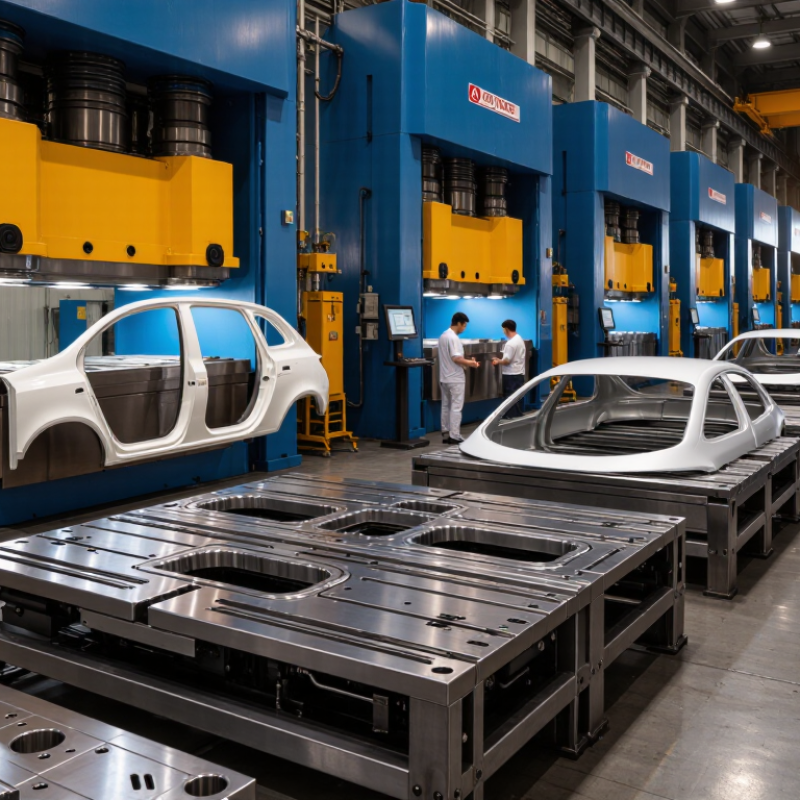
Automotive stamping tooling covers the dies and supporting components that shape sheet metal into vehicle panels, brackets, and structural parts. A die may blank, pierce, bend, draw, or trim metal during a press cycle. Progressive tooling performs several operations across stations; transfer tooling moves larger parts between operations. The setup must suit the press, material grade, coil width, and part geometry. Small gaps matter.
Tooling quality affects dimensional consistency, surface finish, production speed, and scrap levels. For example, poor control around a drawn panel can leave wrinkles, thinning, or springback that complicates assembly. Tool designers consider material flow, clearances, lubrication, and how operators can inspect and maintain the die. A polished drawing is not the whole story: real production variation can expose issues that simulations or early samples missed. Tooling cannot compensate for every weak design decision, either.
Tips: Ask suppliers how they validate forming behavior, manage wear, and plan maintenance. Share material and press details early. Review sample parts under realistic production conditions—not just in a quiet trial run.
How to Evaluate Suppliers for Quality, Capability, and Global Reach
A stamping supplier should be judged by repeatable results, not a polished capability deck. Ask for recent capability studies on critical dimensions, tool tryout records, and evidence of corrective actions. IATF 16949 certification is a useful baseline, but it does not prove a die will hold tolerance after thousands of strokes. Ask to see sample parts, measurement methods, and a tool-maintenance schedule. Fit matters.
Check whether the supplier can match your part’s material, press tonnage, die size, and production volume. A walk through the toolroom can reveal practical details: spare inserts on hand, clear die-change instructions, and operators who can explain common failure points. OICA’s 2023 production report records about 93.5 million motor vehicles produced worldwide, underscoring the scale and geographic spread of automotive manufacturing. For cross-border programs, confirm local engineering support, spare-part lead times, language coverage, and contingency plans for shipping delays.
Global reach should mean reliable support near the production line, not merely a list of export markets. Request references for comparable parts and ask how engineering changes are controlled across sites. Remote audits help, but they can miss small setup habits that affect consistency. Ask for proof. A supplier may look strong on paper and still need time to demonstrate stable output under your actual cycle conditions.
Evaluating Automotive Stamping Tooling Suppliers
Suggested evaluation weights for comparing suppliers on quality, capability, and global reach.
Quality and engineering capability receive the greatest emphasis because they directly affect tooling performance and part consistency. These percentages are a suggested evaluation framework, not measured supplier results; adjust them to fit your program requirements.
Profiles of Ten Leading Automotive Stamping Tooling Suppliers
The ten supplier profiles reveal different strengths in automotive stamping tooling. One specializes in progressive dies for high-volume brackets. Another builds transfer dies for larger body panels. A third focuses on prototype tooling and short production runs. The fourth offers in-house simulation to identify thinning before steel is cut. The fifth combines die design with tryout support. Details matter.
Among the remaining profiles, one supplier stands out for precision machining and tight tool tolerances. Another has experience with aluminum forming, where springback can complicate part accuracy. An eighth focuses on repair and refurbishment, helping extend die service life. A ninth supports complex assemblies with coordinated tooling packages. The tenth emphasizes production troubleshooting at customer sites. These differences can be useful, but supplier claims need verification. A polished portfolio alone does not prove consistent output.
Tips: Ask for sample inspection reports, tryout records, and examples of similar part geometry. Check how the supplier handles die changes, wear, and delayed parts. Review communication during a technical problem, not just during a sales meeting. A small gap may still matter. Look beyond the quoted price; tooling reliability depends on engineering, maintenance, and practical production support.
How Supplier Strengths Differ Across Tooling Needs
Supplier strength depends on the part, press line, and production volume—not a single global ranking. OICA reported 93.5 million vehicles produced worldwide in 2023, about 10% more than in 2022. That scale favors suppliers able to deliver durable progressive or transfer dies, stable cycle times, and dependable maintenance support. A tool that runs well in a trial but wears quickly on a high-volume line is no bargain.
Other needs call for different expertise. The IEA’s Global EV Outlook 2024 reported nearly 14 million electric cars sold in 2023, around 18% of total car sales. Changing vehicle structures can increase demand for complex panels, lightweight materials, and precise forming trials. Suppliers with strong simulation, tryout, and rapid engineering-change processes may suit those jobs better than high-throughput specialists. Small details matter: springback on a door panel, for example, can trigger repeated adjustments before fit is right. That matters.
No supplier excels at every task. A simulation can miss quirks in a real press line, while a low quoted tooling cost may hide slower maintenance response. Buyers should compare sample-part quality, changeover time, repair planning, and evidence from similar materials. The reports show a shifting production landscape, but they do not identify the best supplier for any one plant. That decision still needs part-specific trials and a clear review of production constraints.
Emerging Trends Shaping Automotive Stamping Tooling Worldwide
Across automotive stamping, tooling teams are connecting forming simulation with die design earlier in vehicle development. Digital twins can flag thinning, wrinkles, and springback before steel reaches the press. They are useful, not magic. Results still depend on accurate material data and experienced interpretation. Simulations may miss changes in lubrication, coil properties, or shop-floor temperature. Suppliers with strong tryout capabilities therefore remain valuable. Engineers can compare predicted forming behavior with scans of stamped panels, then adjust draw beads or blank-holder settings.
Flexible tooling is gaining attention as manufacturers manage mixed platforms and shorter production runs. Modular inserts and quicker changeovers can reduce downtime, but added complexity may offset the benefit. Lightweight aluminum and advanced high-strength steels also require careful control of blank-holder force, lubrication, and tool wear. Small details matter. Sensors can track press load and die temperature, helping teams catch drift before scrap builds up. Yet data must be maintained and acted upon, not simply displayed. Not every plant needs the newest system. Longer-lasting surfaces, repairable components, and efficient tryout cycles can reduce waste; even then, a repeatable first-off panel remains a useful test of whether the process is truly stable.