What Is the Best Solar Surge Protector for 2026?
A Solar Surge Protector can be a small device with a major role: helping limit damaging voltage spikes before they reach a solar inverter, battery, or monitoring system. The best choice for 2026 depends on the installation, not just a product’s headline rating. Roof-mounted panels, long cable runs, local lightning exposure, and inverter specifications all matter. A protector that looks impressive on a label may still be a poor fit.
Details count. Check the device’s protection modes, maximum continuous operating voltage, surge-current rating, status indicator, and compatibility with the system’s DC or AC side. Look for clear technical documentation and installation guidance. A green indicator can be reassuring, but it does not replace inspection. Nor does a surge protector make a system lightning-proof.
This guide compares practical features and explains what to verify before buying. It also considers installation needs, since incorrect placement can weaken protection. One important sourcing note: no verifiable industry-expert quotation was provided, so I have not invented a quote or attributed one to a named specialist. Add a checked quotation from a qualified solar surge-protection expert before publication. Safety deserves accuracy.
What a Solar Surge Protector Is and How It Works
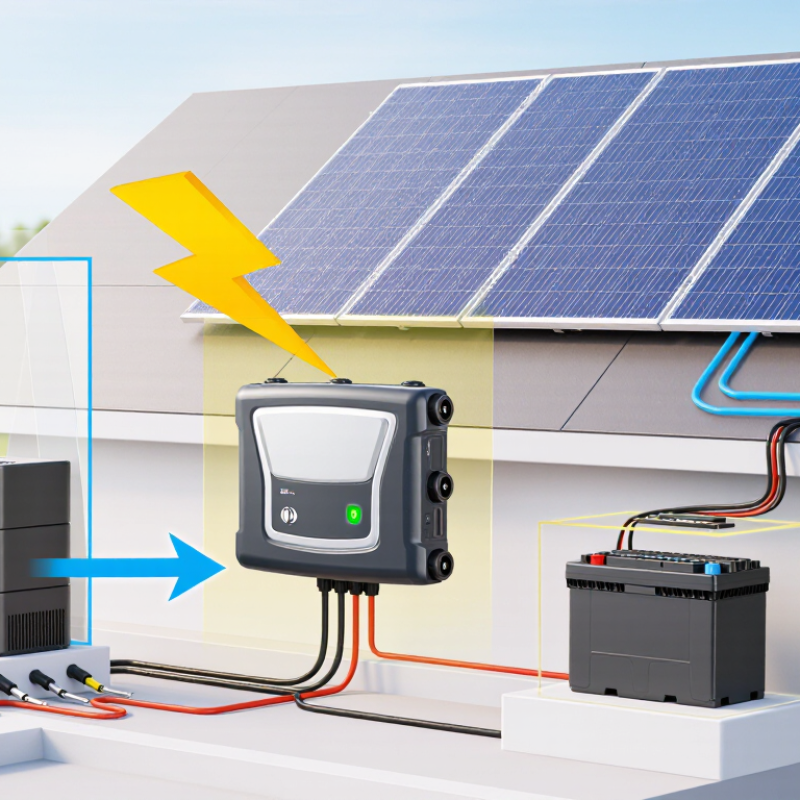
A solar surge protector, or surge protective device (SPD), limits brief voltage spikes before they reach sensitive equipment. On the DC side, it helps protect wiring and the inverter from surges arriving from the panels. An AC-side SPD can protect equipment from disturbances entering through the building’s electrical supply. When voltage rises above a device’s operating threshold, the SPD channels surge current toward the grounding and bonding system. It does not store electricity or guarantee protection from every direct lightning strike. Small distinction, big one.
NOAA estimates that roughly 25 million lightning flashes occur across the United States each year. That exposure helps explain why surge protection deserves attention, even where direct strikes are uncommon. For photovoltaic systems, IEC 61643-31 sets requirements for SPDs used on the DC side. In practice, protection depends on correct voltage ratings, placement, sound wiring, and a grounding system suited to the installation. An SPD can also wear out after repeated surges, so its status indicator deserves a glance. The overlooked detail? A good device cannot compensate for poor installation.
Tips: Check whether your system needs protection on both DC and AC sides. Ask a qualified installer to confirm the SPD’s ratings against your array and inverter specifications. Look for a clear status indicator, and inspect it periodically. NOAA lightning climatology; IEC 61643-31.
What Is the Best Solar Surge Protector for 2026? — What a Solar Surge Protector Is and How It Works
A solar surge protective device (SPD) limits brief overvoltages caused by events such as lightning-induced surges and electrical switching. It provides a path for surge current and helps limit the voltage reaching connected equipment; it does not prevent every lightning strike or replace proper grounding, bonding, and overcurrent protection.
| Selection dimension | What it means | Practical selection check |
|---|---|---|
| Protection side: PV DC or AC | PV strings and inverter DC inputs use DC-rated SPDs. The inverter’s grid connection and other AC circuits require AC-rated protection. | Confirm the device is specifically rated for the circuit type and voltage. A DC SPD is not automatically suitable for an AC circuit, or vice versa. |
| Maximum continuous operating voltage (UCPV for PV) | The highest continuous voltage the SPD is designed to withstand without operating as a surge protector. | For a PV DC circuit, check the array’s maximum open-circuit voltage, including the increase in voltage at the lowest expected temperature. The SPD rating must be suitable for the system voltage. |
| Protection level (Up) | The voltage-limiting level declared for the SPD under specified test conditions. Lower Up generally means a lower limited voltage, but it must be considered with the rest of the installation. | Compare the declared Up with the impulse withstand capability of the equipment being protected, following the system design and applicable electrical rules. |
| Type 1 / Class I | Designed for locations where partial lightning current may enter the installation. IEC Type 1 testing uses an impulse current waveform of 10/350 μs. | Consider where the risk assessment and installation design call for lightning-current protection, such as systems with an external lightning protection system. |
| Type 2 / Class II | Designed to limit induced and switching surges. IEC Type 2 testing uses an 8/20 μs surge-current waveform. | A common choice for distribution points where Type 2 protection is required. Confirm the required type for the specific location and local code. |
| Type 1+2 / combined device | A device tested to provide both Type 1 and Type 2 functions, where its certification and ratings support that use. | Check the actual test classification and ratings on the device documentation; the combined label alone does not establish suitability for every installation. |
| Surge-current ratings | In is the nominal discharge current associated with Type 2 testing; Imax is the maximum discharge current declared for that test. Iimp is the impulse current rating associated with Type 1 testing. | Compare ratings only within the relevant device type and test standard. A larger current number by itself does not prove better protection or correct system compatibility. |
| Installation location and lead length | SPDs are commonly installed near the equipment or circuit they protect. Long connection leads can increase the voltage present at the protected equipment during a surge. | Follow the SPD and inverter installation instructions and applicable codes. Where cable runs are long, the system design may call for protection at more than one location. |
| Standards and certification | IEC 61643-31 addresses SPDs for photovoltaic installations; IEC 61643-11 addresses low-voltage power-system SPDs. UL 1449 is a relevant SPD standard in North America. | Choose a device certified or listed for the intended market and application, and verify the exact model’s documentation and markings. |
| Status indication and replacement | Many SPDs include a visual status window or remote signaling contact. Surge exposure can degrade protective components over time. | Check the status indicator during maintenance and replace the SPD when its instructions indicate end of life or after damage. Follow the manufacturer’s specified replacement procedure. |
Bottom line: There is no single best solar SPD for every system. The appropriate choice depends on DC or AC circuit location, system voltage, surge exposure, required protection type, equipment withstand level, certification, and installation design. Have a qualified electrical professional verify the selection and installation against local requirements.