Choosing a Solar Pv Hybrid Inverter in 2026 means matching real household needs to measurable equipment limits. The IEA’s Renewables 2024 report estimated that solar PV would account for nearly 550 GW of the almost 700 GW of renewable capacity added worldwide that year. That scale matters: buyers face more models, but specifications can still hide important differences.
“Solar is now the cheapest electricity in history,” IEA Executive Director Fatih Birol said in 2020. His statement concerned solar power economics, not inverter performance. Still, lower panel costs make the inverter’s role in storing and delivering energy more visible. Compare continuous and peak output, battery compatibility, MPPT inputs, backup transfer time, and efficiency under partial load. Check the actual datasheet, not just the brochure. A 10 kW label does not guarantee 10 kW of backup power.
Look closely. A hybrid inverter may not support every battery, or provide whole-home backup during an outage. The IEA’s Renewables 2024 analysis also highlights solar PV’s central role in future renewable growth, but global forecasts cannot predict your roof’s output. Shade from one chimney can change the numbers. Ask an experienced installer to model seasonal production, evening demand, and battery reserve settings. Compare warranty terms and local service access, too. One detail is easy to miss: compatible equipment on paper may still require specific firmware or configuration. The right choice is rarely the largest unit. It is the one that fits your loads, storage plans, and site conditions—with assumptions you can verify.
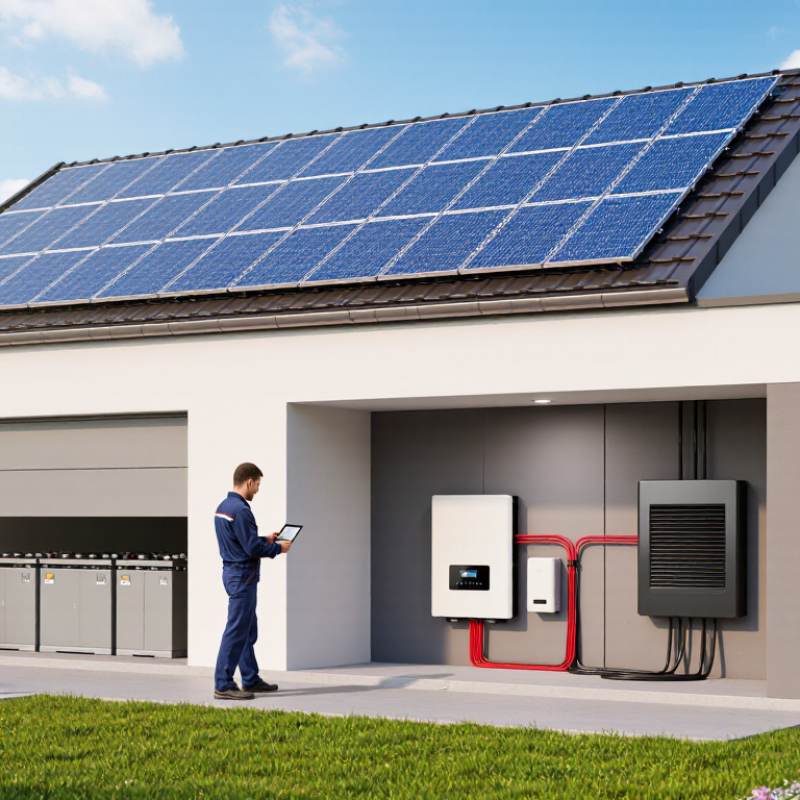
A solar PV hybrid inverter manages electricity from panels, a battery, the grid, and household loads. It converts the panels’ direct current into alternating current for appliances. When sunlight exceeds demand, the inverter can send surplus power to a battery or the grid, depending on system settings. After sunset, it can convert stored battery power for household use. The catch? A hybrid inverter does not automatically guarantee backup during an outage. Backup depends on compatible battery equipment, isolation controls, and the inverter’s rated output.
The scale of solar makes these operating details increasingly relevant. IEA PVPS’s Trends in Photovoltaic Applications 2024 reports that global solar capacity exceeded 1.6 terawatts by the end of 2023. When comparing units, check battery charging limits, conversion efficiency, and continuous and peak output.
For example, a refrigerator may draw modest power while running, yet need more briefly when its compressor starts. That short surge can matter. Also ask whether backup covers selected circuits or the entire home; those are different design choices. A clean specification sheet can still leave this unclear. In practice, matching the inverter to the battery, panel voltage range, and real household loads takes more than choosing the highest wattage.

Before choosing a hybrid inverter, collect at least 12 months of electricity bills and note seasonal changes. The U.S. Energy Information Administration reports that residential utility customers used an average of 10,791 kWh in 2022, or about 899 kWh monthly. That is a reference point, not a sizing rule. Your home’s heating, cooling, cooking, and vehicle charging can shift demand sharply.
Then identify what must stay powered during an outage. List essentials such as the refrigerator, internet router, selected lights, and a medical device if needed. Record each load’s watts and expected hours of use. A refrigerator may draw modest power while running but need extra surge capacity at startup. Small detail. It matters. Avoid assuming the whole house needs backup; that can push inverter and battery costs higher than necessary.
Match the inverter’s continuous output and surge rating to those loads, then check whether the battery can supply them through the expected outage period. Review evening use too: solar production may fall just when cooking and lighting demand rises. EIA averages cannot predict your household’s outage needs, so test your estimate against actual bills and appliance labels. Leave room for uncertainty; backup plans are rarely perfect.
Choosing a solar PV hybrid inverter in 2026 starts with capacity, not a headline efficiency figure. Compare its continuous output with your household’s likely peak load. A 5 kW inverter may run lights and a refrigerator comfortably, yet struggle when a kettle and heat pump start together. Check surge capacity, too. Array size and battery limits should also match the inverter’s specifications. No sizing rule is perfect.
Tips: List the appliances you expect to run during an outage, then note which ones start at the same time. Leave practical headroom for future loads. Ask an installer to explain any proposed oversizing in plain terms.
Efficiency figures need context. Look for conversion efficiency across realistic operating loads, not just the highest number on a datasheet. At low output, performance can differ, especially on cloudy mornings. Operating modes matter just as much: confirm how the unit prioritizes solar power, battery charging, grid supply, and backup. Some systems switch quickly; others may pause briefly during a changeover. Check backup output, supported battery voltage, and whether essential circuits need separate wiring. These details are easy to overlook, and I would revisit them before comparing prices.
A hybrid inverter must match the battery, panel array, and grid as one system. Start with the battery’s operating-voltage range, maximum charge and discharge current, chemistry, and BMS communication protocol. A connector that fits does not prove compatibility. Confirm the inverter and battery can exchange limits and fault signals, especially during a power outage. Easy to miss.
Next, compare the solar array’s cold-weather open-circuit voltage and operating current with the inverter’s maximum PV input and MPPT range. A string that exceeds the voltage limit on a frosty morning can be a poor choice, even if its summer output looks fine. NREL’s 2024 Annual Technology Baseline uses 85% round-trip efficiency as a benchmark for utility-scale lithium-ion storage. That figure is not a promise for a home system; conversion losses, temperature, and battery settings affect real performance. Check the proposed system’s own datasheets.
Grid compatibility matters too. Verify nominal voltage, phase, frequency, export settings, and backup-output limits against the site’s supply and utility interconnection requirements. IEA PVPS reported more than 1.6 terawatts of cumulative global PV capacity by the end of 2023, but a global trend cannot confirm a local connection will work. Ask the installer to document each device’s permitted ranges and communication settings. I still check the cold-weather voltage calculation twice. Databases and datasheets can lag behind revisions, so confirm the exact model numbers before purchase.
| Compatibility Check | Typical Residential Specification | What to Confirm Before Buying | Potential Mismatch |
|---|---|---|---|
| Battery voltage | Low-voltage systems commonly use a nominal 48 V battery; high-voltage systems vary by inverter and battery design. | Match the inverter’s approved battery voltage range to the battery’s nominal voltage and operating limits. | A battery with the wrong voltage class will not operate correctly, even if its capacity is suitable. |
| Battery chemistry and communication | Lithium iron phosphate (LFP) and lead-acid batteries are used in some systems; supported types vary by inverter. | Check the inverter’s battery compatibility list, charge settings, and supported communication protocol, such as CAN or RS-485, if required. | Unsupported communication or charge settings can prevent battery control, reduce performance, or affect warranty coverage. |
| Battery power and capacity | Residential battery capacity is often several kilowatt-hours per battery unit; usable capacity and continuous power are model-specific. | Compare the battery’s continuous charge/discharge power and usable capacity with the inverter’s limits and household backup needs. | A large-capacity battery may still be unable to supply the inverter’s full output if its power rating is too low. |
| PV operating voltage | Residential hybrid inverters commonly have MPPT operating ranges in the tens to several hundred volts DC; exact ranges differ by unit. | Check that each proposed string’s cold-weather open-circuit voltage stays below the inverter’s maximum PV voltage and that operating voltage falls within its MPPT range. | Exceeding the maximum DC voltage can damage equipment; voltage outside the MPPT range can prevent effective tracking. |
| PV input current and string layout | Inverters may provide one or more MPPT trackers, each with a specified maximum operating and short-circuit input current. | Compare the panel string current and parallel-string arrangement with the limits for each MPPT input. | Too much current can exceed input limits; placing differently oriented or shaded arrays on one tracker can reduce energy production. |
| PV array power | Many residential hybrid inverters allow a DC solar array rating above their AC output rating, within a stated maximum PV input power. | Check the inverter’s permitted PV oversizing ratio and total PV input rating, not just its AC kilowatt rating. | An oversized array beyond the stated limit may be disallowed; an undersized array may not meet energy goals. |
| Grid voltage and phase | Common supplies include 120/240 V split-phase, 230 V single-phase, and 400 V three-phase systems, depending on the country. | Confirm the inverter is designed for the local grid voltage, phase configuration, frequency, and applicable grid-code settings. | An inverter intended for a different voltage or phase configuration may not connect to the local grid. |
| Backup output | Some hybrid inverters provide backup power through a dedicated output; backup power and surge limits are model-specific. | Check continuous and surge output ratings, supported loads, transfer behavior, and whether an external changeover or backup panel is required. | Motor-starting loads or whole-home demand may exceed the backup output even when normal consumption is within range. |
| Grid connection and export | Export control, zero-export operation, and permitted grid feed-in depend on inverter features and local utility rules. | Verify utility approval requirements, export limits, required metering equipment, and local electrical regulations. | A technically compatible inverter may still require approval, configured export limits, or additional metering. |
| System sizing example | A 5 kW hybrid inverter could be paired with a PV array and battery only when their voltage, current, power, and communication specifications all fall within its published limits. | Use the inverter, panel, and battery datasheets together; have string voltage checked at the site’s minimum design temperature. | Matching only the headline kilowatt ratings does not establish electrical or grid compatibility. |
| Note: Values and configurations above are general selection guidance, not guaranteed specifications for every inverter. Always confirm the exact model datasheets, local grid requirements, and installation rules before purchase. | |||
How to Choose a Solar PV Hybrid Inverter in 2026?
A hybrid inverter handles solar power, batteries, and household loads, so safety deserves close attention. Check for protection against overloads, short circuits, overheating, and ground faults. Ask whether the unit includes arc-fault detection and a clearly accessible isolation switch. The label matters, but so do the installation manual and test records. Confirm the inverter is compatible with your battery’s chemistry and voltage range.
Installation details can affect both reliability and safety. Ask a qualified installer to assess wall strength, ventilation, clearances, cable routes, and exposure to moisture or dust. A cramped utility room may need better airflow; long cable runs can also affect system design. Review how the inverter will connect to your existing electrical equipment. I would not rely on a neat-looking installation alone. Some details are easy to miss.
Tips: Compare warranty terms in writing. Check coverage length, battery-cycle limits, labor costs, shipping, and exclusions. Confirm who handles a claim and whether registration is required. Keep your invoice, commissioning report, and system settings together. If a term is unclear, ask before signing; warranty language can be less simple than it looks.
Suggested evaluation weights for comparing hybrid inverters. These are a practical scoring framework, not market survey results or manufacturer ratings.
Score each product against its datasheet, warranty terms, and local electrical requirements. Prioritize certified protection features, installation compatibility, and clear warranty coverage.