Why Choose a Heat Recovery Ventilator for Your Project?
Choosing the right ventilation system affects indoor air quality, energy use, comfort, and long-term operating costs. A Heat Recovery Ventilator can address these needs by exchanging stale indoor air with outdoor air while transferring heat between the two airstreams. During winter, outgoing warm air can preheat incoming cold air. In summer, the process can reduce the cooling load.
The value becomes clear in real project conditions. Imagine a tightly sealed home with bedrooms, bathrooms, and a utility room operating throughout the day. Without balanced ventilation, moisture, odors, and carbon dioxide may accumulate. A correctly selected Heat Recovery Ventilator provides continuous air exchange while limiting unnecessary energy loss. It can also support stable indoor temperatures and reduce pressure imbalances between rooms.
However, the equipment is not a universal solution. Its performance depends on climate, building airtightness, duct design, filter quality, and commissioning. Small mistakes matter. An undersized unit may fail during peak occupancy, while an oversized system may create noise and waste energy. Maintenance matters too. Dirty filters restrict airflow, even when the control panel shows normal operation.
Professional design should consider airflow calculations, acoustic requirements, access for servicing, and applicable ventilation standards. Qualified engineers and contractors can verify these details through site measurements and commissioning tests. Project owners should also compare seasonal efficiency, controls, warranty support, and replacement filter availability. The best choice is rarely the most expensive model. It is the system that matches the building, climate, occupants, and maintenance capacity. Careful evaluation prevents attractive specifications from becoming disappointing results.
How a Heat Recovery Ventilator Works
Why Choose a Heat Recovery Ventilator for Your Project?
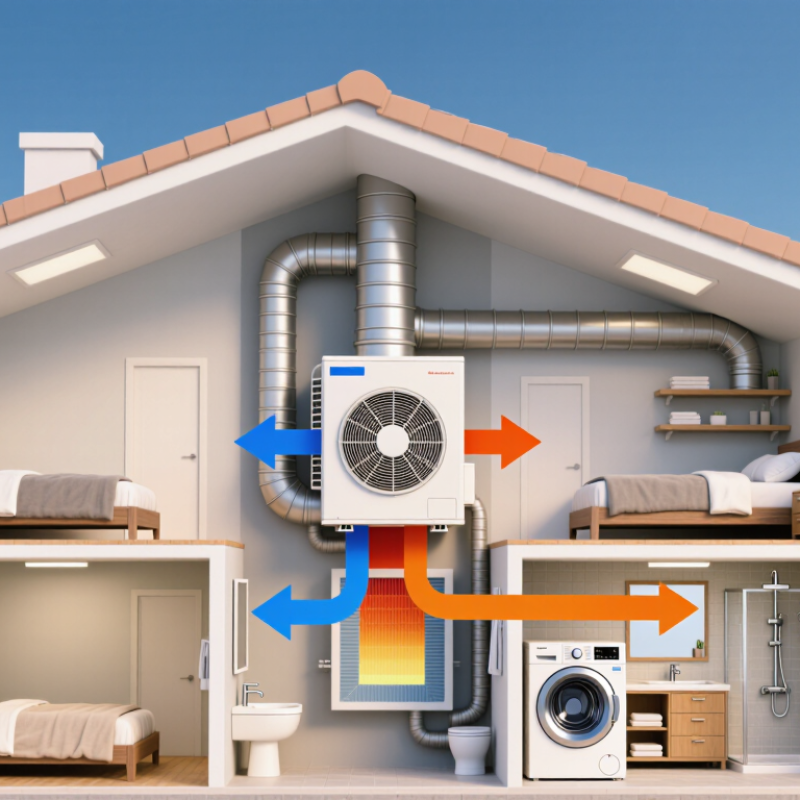
A heat recovery ventilator, or HRV, exchanges stale indoor air with fresh outdoor air. It does this without simply opening a window. Two separate airstreams pass through a heat exchanger. Warm exhaust air transfers heat to incoming cold air. In summer, the process can reduce the heat entering from outside. The air streams remain separated.
This helps protect indoor comfort while supporting continuous ventilation. Natural Resources Canada reports that well-designed HRV systems can recover up to 80% of heat from exhaust air. The U.S. Environmental Protection Agency also notes that indoor pollutant levels can reach two to five times outdoor levels. Fresh air needs control, not guesswork. Filters remove some particles, while balanced airflow limits drafts and pressure problems.
Performance depends on more than the unit. Duct length, airflow balance, climate, frost control, and maintenance all matter. ASHRAE guidance emphasizes proper ventilation rates and commissioning for reliable indoor air quality. A neglected filter can quietly reduce airflow. That part is often underestimated. Actual heat recovery may fall below published figures in a poorly installed project. Designers should verify airflow at the grilles and inspect the core regularly. A small measurement error can affect an entire floor.
Key Benefits of Heat Recovery Ventilation
Why Choose a Heat Recovery Ventilator for Your Project?
Key Benefits of Heat Recovery Ventilation
In a tightly sealed building, fresh air must enter through a controlled system. The EPA reports that indoor pollutant levels can be two to five times higher than outdoors. A heat recovery ventilator removes stale air and supplies filtered outdoor air. Its core transfers heat between the two airstreams without mixing them. DOE Building America guidance reports that many residential HRVs recover approximately 70–80% of sensible heat under rated conditions. That matters.
During winter, outgoing warm air preheats incoming air. During summer, outgoing cool air can temper the outdoor supply. This reduces ventilation-related heating and cooling loads. It also supports steadier indoor temperatures. ASHRAE guidance warns that performance depends on airflow balance, duct leakage, frost protection, and maintenance. Real buildings rarely match laboratory conditions. Design matters.
An HRV can improve comfort in bedrooms, classrooms, and offices with limited window ventilation. Balanced airflow may also help control excess humidity. However, it cannot remove every pollutant or replace source control. EPA ventilation guidance still emphasizes moisture management and pollutant reduction at the source. The IEA’s Buildings 2023 report states that buildings represent about 30% of global final energy consumption. Recovered ventilation heat can therefore support efficiency goals, especially in colder climates. Yet savings vary widely. Commissioning should measure airflow, carbon dioxide, humidity, fan power, and filter pressure after occupancy. A neglected filter can quietly reduce expected performance.
When Your Project Needs an HRV
Why Choose a Heat Recovery Ventilator for Your Project?
When Your Project Needs an HRV
A heat recovery ventilator suits projects with airtight envelopes and limited natural air leakage. New homes often need this controlled ventilation. Renovated buildings may need it after insulation and window upgrades. If indoor air feels stale, an HRV can exchange it with outdoor air while transferring heat between airstreams.
I have seen moisture collect on bedroom windows when ventilation was treated as an afterthought. An HRV can reduce this risk by removing humid air from bathrooms, kitchens, and utility rooms. It also helps dilute indoor pollutants from furnishings, cleaning products, and everyday occupancy. However, performance depends on correct sizing, duct design, and regular filter replacement. Bigger is not automatically better.
One detail is easy to miss. The project’s climate matters. In cold regions, frost control and condensate drainage require careful planning. In mild climates, excessive ventilation may waste energy or create uncomfortable drafts. A qualified designer should review occupancy, floor area, airtightness, local building requirements, and expected humidity levels. Commissioning should confirm airflow at each supply and exhaust point. Even then, real life can be untidy. Occupants may block grilles, forget maintenance, or change room use. The system should allow simple access, clear controls, and practical servicing.
How to Choose the Right HRV System
Why Choose a Heat Recovery Ventilator for Your Project?
Choosing the right heat recovery ventilator begins with the building, not the equipment catalogue. Measure floor area, occupancy, airtightness, and expected moisture levels. A crowded apartment needs different airflow from a small workshop. Check local ventilation requirements before comparing models. Compliance should guide the design.
Look at the unit’s effective airflow, heat recovery efficiency, filter class, and seasonal performance. Do not rely only on the highest advertised airflow. That figure may apply at low resistance. Ask for performance data at the pressure your ductwork will create. Short, balanced ducts usually reduce energy use and fan noise. Include access space for filter changes and inspection.
Climate also matters. In cold regions, confirm frost protection and condensate drainage. In humid regions, examine moisture control and summer bypass operation. Place supply grilles away from beds and desks. A quiet system can still feel uncomfortable if air blows directly onto people. During commissioning, measure supply and extract airflow at each terminal. Small imbalances can affect comfort.
A common design mistake is choosing capacity for a future extension that may never happen. Oversizing can increase noise, cost, and cycling. I would rather see measured assumptions than impressive guesses. Still, every project has uncertainty. Ask the installer to document settings, maintenance intervals, and commissioning results. Keep those records with the building documents.
A heat recovery ventilator can reduce ventilation-related heating demand by transferring heat from outgoing air to incoming fresh air. This comparison estimates the annual heat recovered at different sensible heat recovery efficiencies, using a continuous airflow of 200 m³/h, an average indoor–outdoor temperature difference of 15°C, and 8,760 operating hours per year. Actual results depend on climate, airflow, controls, and system operation.
Installation, Controls, and Ongoing Maintenance
A heat recovery ventilator earns its place when fresh air is needed without wasting indoor heat. Installation determines whether that promise becomes real. The unit should sit on a level, solid surface with enough clearance for filter removal. Keep supply and exhaust ducts short, sealed, and properly insulated. Outdoor intake and exhaust openings need separation from traffic fumes, vents, and snow accumulation.
Airflow balance matters. An installer should measure both air streams after commissioning, rather than trusting factory settings. Small errors can create drafts, noise, or pressure problems. I have seen layouts that looked tidy but restricted access to the condensate drain. That detail became expensive to correct. Leave room for tools, not just the equipment.
Controls should match how occupants use the building. A simple wall controller may suit a small office, while timed boosts can help kitchens, meeting rooms, or bathrooms. Sensors can respond to humidity or carbon dioxide, but incorrect settings may cause unnecessary fan operation. Test every mode before handover. Ongoing maintenance is practical, not optional. Inspect filters regularly, clean the heat exchanger as instructed, and check drains for blockage. Record airflow readings and service dates. A neglected filter quietly reduces performance. Even experienced teams can miss that. The maintenance schedule may need adjustment after the first season, especially in dusty or humid conditions.